Research vision
Understanding the dialogue between neurons and glia.
How do neurons and glia independently and cooperatively organize a nervous system that can change throughout life while preserving its essential connections?
Our entry point
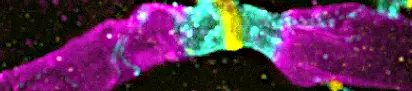
The paranodal junction, the largest intercellular adhesive junction in vertebrates, represents a precisely organized interface where a myelinating oligodendrocyte physically contacts an axon for direct cell-cell interactions. It provides a robust structural and functional readout for any defects in this communication.
Our central hypothesis
We propose that the paranode serves as a dynamic site of communication rather than merely a passive anchor. Understanding how it is assembled, maintained, and remodeled may reveal how oligodendrocytes respond to and influence the axons they contact.
Questions guiding our future program
01 · building polarized cells
How do neurons and glia build specialized domains?
The cells in our nervous system are highly polarized, with specialized subcellular domains performing distinct functions. For instance, a neuron in your brain may extend an axon over a meter in length, building an information highway where the signal needs to be synthesized, transmitted, and properly interpreted along a specific direction. We aim to define how membrane lipids, protein scaffolds, and the cytoskeleton establish specialized domains in neurons and oligodendrocytes. Palm2 provides a starting point for asking how a shared protein can be positioned and regulated differently across cell types and developmental stages.
Membrane identity · Cytoskeletal coupling · Cell-specific regulation
02 · using shared molecules
What is the molecular "zip code" that tells a protein where to go?
A cell’s molecular inventory is only part of its story. We want to understand how different cells can utilize their shared genetic material and molecular toolkits differently. For instance, how the same proteins are directed to distinct subcellular destinations in different cellular contexts through alternative splicing, post-translational modifications, or lipid modifications that change the local environment. How are molecular “zip codes” written? Looking ahead, we also aim to develop new tools for RNA manipulation and lipid analysis with better efficiency, cell-type specificity, and spatial resolution.
Alternative splicing · RNA manipulation · Spatial lipid biology
03 · Reparing the connection
Why do some connections fail, and can we restore them?
Aging, demyelination, and axonal injury offer different windows into how these interfaces become vulnerable—and whether restoring them can support recovery. Does disruption of these connections during early development cause long-lasting adverse effects?
Development & aging · Axonal injury · Myelin repair
From discovery to mechanism
The right molecules. In the right biological context.
Our approach connects discovery in native molecular environments with functional tests in living systems.
Map
Resolve molecular neighborhoods
Endogenous proximity proteomics identifies proteins associated with specialized subcellular domains.
test
Manipulate endogenous proteins in vivo
Endogenous proximity proteomics identifies proteins associated with specialized subcellular domains.
connect
Link organization to function
Imaging, biochemistry, physiology, and behavior connect molecular changes to nervous system consequences.
The longer view
One oligodendrocyte. Many axons. Shared possibilities.
How does an oligodendrocyte integrate information from the many axons it contacts? Could the state of one axon influence others through their shared glial partner? These open questions motivate our long-term interest in glia as active participants in nervous system function.
Ding Lab est. 2027· Axon–Glia Interactions